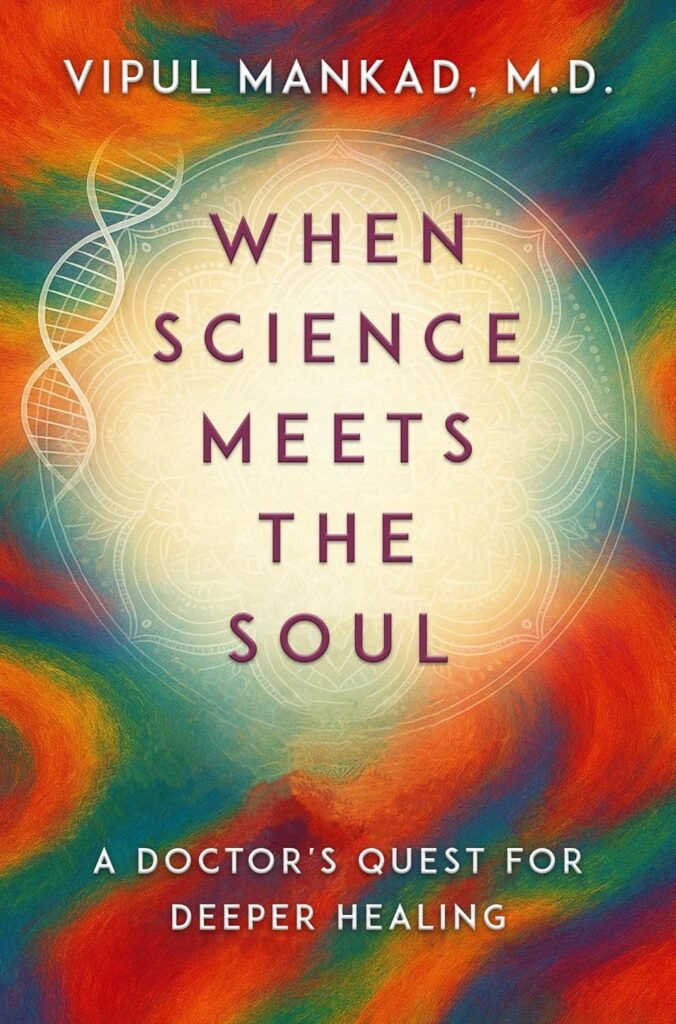
When Science Meets the Soul
In the book, When Science Meets the Soul: A Doctor’s Quest for Deeper Healing, Dr. Mankad presents an examination of fundamental questions about life and the Universe: Who am I? Who might you be? What is the Universe made of? How do we relate to each other and to the Universe? The book is illustrated by his own life events in the context of the cultural influences and through the genetic cards he was dealt. Rather than accept external labels assigned by others, he contemplates the inner core of his being, the soul, if you will, which allows him to keep a mental balance in our turbulent world. He does not preach; rather, at the end of each chapter, he challenges the reader to engage in the search for the truth through contemplation.
- ISBN: 9789370025370
- Page: 369
- Size: 6×9
- Language: English
- Category: SELF-HELP / General
Released Worldwide
The first part is about the world community, in particular the cultures of India and the U.S. He presents his life events, family, and social environment, including discrimination and meritocracy, both in India and the US. No culture is perfect; thus, achieving mental balance requires determining the path based on one’s own value system. Also presented are seriously ill children treated by him, who taught him to be a better human being. Over the years, an African proverb, “It takes a village to raise a child”, has become an inadequate cliché. In our globalized planet, Dr. Mankad proposes a revision of the proverb to include the role of the world community in developing the full potential of an individual.
The second part concerns itself with the history of the human race, with emphasis on Indian history, the sciences of archeology, linguistics, population genomics, and his own family’s genome. The interplay of nature and nurture, genes and environment, and history and heritage, with its proud moments and embarrassing baggage, shape what he calls a mind-body machine. How do we understand our nature and nurture, and past experiences that contribute to our mind and body? Understanding the interplay will allow us to rise above our selfish survival genes and baggage of history to play the game of life well.
The third part is a philosophical, religious, and spiritual exploration of who we are at our core; consciousness behind our mind-body machine. It presents comparisons of religious traditions, yoga, and meditation, and addresses the mysteries of consciousness. What is the nature of consciousness? How is it created? What happens to it when the body-mind machine sleeps, is given anesthesia, or stops operating? Yoga teaches us to give up our lust, fear, anger, anxieties, and delusions. Then, the next step of the meditation is to eliminate our ego and arrogance, and with a still mind, witness the pure consciousness within. He also discusses how one determines what a good life is. He raises the most fundamental question of all, “Who Am I?” and synthesizes Eastern and Western cultures, science, philosophy, and spirituality to explore the answers. He concludes the book with a discussion of who we are at the core of our being, i.e., the pure consciousness, what the universe is made of, and our relationship with it.