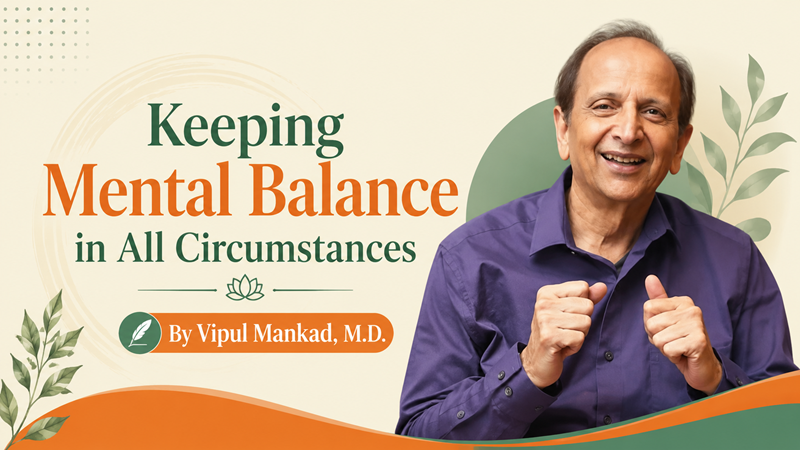
We often wonder who we are, why we are here, and what is the purpose of life. These are age-old, weighty questions that philosophers have raised and attempted to answer. However, these questions have practical implications in our daily life. Contemplation about our external labels, avoiding comparisons with external labels of others (so-called “Keeping up with the Joneses”), and learning to realize our true “Self” will allow us to keep mental equipoise in our agitated world. This process allows us to live a Good Life. In my forthcoming book, “Who Am I? Culture, Science and the Search for Soul”, I address these questions and demonstrate how one can keep a mental balance under stress.
External Labels:
As soon as we are born, we are labeled, first with a name. Other labels come from our historical, cultural, and genetic lottery, i.e., the cards we have been dealt with in the game of life. Thus, we are either black or white or brown, Indian or Chinese or Irish, and so on. As we receive education and training, additional labels are added.
When a question is asked, “Who are you?”, the first response to such a question is often, “I am a lawyer in Chicago” or “I am a successful Indian immigrant.” These descriptors do have an impact on our lives. However, the question can also be answered not simply by elaborating on external features such as our name, race, nationality, profession, social status, relationships, or net worth. These are external descriptors. Who are we at the core of our being?
Change the world or change our reaction to it?
We often like the world to change and adapt to us but rarely think about the way we react to the world when we can’t change it. By all means, if we can change the world to make it better, we should. In my book, I am presenting a way to change the way we react to the world. Rejecting the labels and characterizations emanating from our world, our ethnic history and our personal experiences can calm our minds and lead to inner bliss. And yes, an exploration of who we really are is necessary if mental equipoise and the good life are our goals.
My Own Mental Balance Journey and the Search for Soul
When I traveled from India to the United States in the late 60s, the new world began to change me as a person. Rapidly! Thus began a serious introspection on who I am and what I want to be. My parents, extended family, teachers, town, and the country of India had formative contributions to my identity, which can never be erased. However, my experiences in the United States shaped me as well. First the culture shock experienced immediately upon arrival in the United States, and over a longer period, opportunities and challenges and discrimination and meritocracy inherent in the American society had a great impact on my life. Discrimination based on my national origin, brown skin, and presumed religious beliefs placed serious obstacles along the path and created stress and disappointment. Yet, the world’s best but not yet perfect merit-based system allowed me to circumvent the obstacles until I hit the glass ceiling. My professional work as a specialist treating children with serious illnesses and my brave patients made me a better human being. Keeping a focus on my duty without worrying about results has been a principle, a work ethic, learned through the Bhagavad Gita that allowed me to keep a mental balance.1
Spirituality and meditative yoga allowed me to reject the labels and maintain mental equipoise through challenges and opportunities. It has not been a one-shot deal; it is a journey and a work in progress.
Nature (genes) vs Nurture (environment)
Human history has an obvious impact on our physical and mental constitution and, therefore, provides answers, at least in part, to the question, “Who am I?”. Since we all share early human history spanning 300,000 years and our recorded historical differences can be traced to the last 10,000 years only, a similar analysis would answer the question, “Who might you be?”
How did modern humans (Homo sapiens) evolve and migrate from Africa to Eurasia and the Indian Subcontinent (and eventually to East and Southeast Asia, Australia, and the Americas)? What impact did they make on us?
How does knowledge about DNA, genes, genome, population genomics, migrations, empires, and cultural history help me understand who I am?
The early history of how modern humans evolved and migrated from Africa to Eurasia, India, China, Australia, and the Americas is shared by every human on earth. All of us share the impact of the cradles of civilizations in Mesopotamia, Egypt, China, and India. Depending on our inheritance, where we grew up determines our later history. Although those paths may be different for each of us, there are common features; some we can be proud of, while others can be considered embarrassing historical baggage. No one grows up in a vacuum. We are all products of our history, part of which is part cultural and part genetic.
Genes we inherit are made up of DNA, and like proteins, fats, carbohydrates, sodium, or potassium, they are chemical molecules, i.e., not alive by themselves. If one were to put together a large number of DNA molecules, it would look like a white material similar to the snot from our nose. Although DNA molecules are critically important to life as we know it, those molecules are not conscious. No one has identified a gene or a set of genes or a set of neurons from which consciousness emerges.
Similarly, the planet Earth, our only home, is beautiful with its mountains, rivers, oceans, and beaches and ferocious like the volcanoes and storms within it. We, the people, create nations, governments, and banks; fly in airplanes; and eat the food produced from Earth, but none of these explain our consciousness.
Conceptually, I suggest we separate my body-mind apparatus from the consciousness within. We know genes affect the structure and function of the body. Since mental activities occur in the brain, which is a part of our body, we know genes influence mental function, which is also modified by the environment. However, there is no evidence that the body-mind machine creates consciousness, and no DNA sequences or a collection of neuronal synapses are specifically known to produce consciousness.
When this mind-body machine suffers from wear and tear, eventually, it will need to be discarded, like a worn-out bicycle, a beat-up car, or a metal-fatigued airplane. The DNA, proteins, fats, carbohydrates, and minerals that make my body will eventually decompose into their constituents. They will turn into fertilizer for some plants and food for worms and other animals in the upper food chain. Some may remember my work for a few years, maybe even a hundred years, but my curriculum vitae or published papers do not have a permanent value. My wealth will last only a finite time after my death.
Knowledge of cosmic events and prehistoric and historical events makes me, this body and mind apparatus named Vipul, more humble. Attributes such as Indian, Bhartiya, possibly an heir to the Indus Saraswati Valley Civilization, and the Vedic Tradition, as well as modern civilizations, describe my outer shell — my body and mind. Is that who I am at the core? No, that is just a package in which my consciousness is wrapped.
If you as a reader have a different ancestral or ethnic background, your body-mind package, your family’s history, and your genome will be slightly different. However, ninety-nine percent of our genes are identical, which is not a surprise because nearly all human beings share nearly the same anatomy and physiology. Our differences are only “skin deep.” The five races by which many of us divide our societies are human constructs and are not genetically distinct. At the core, each of us has pure consciousness within, and at that level, there is not an iota of difference between you and me.
Impact of Meditation on Our True Self
Knowing our true Self should allow us, you and me, at our core, the same conscious beings, I would say divine beings, to rise above the petty labels and use our body-mind machine for the welfare of others. Contemplation and meditation on our core being, our pure consciousness, allow us to not simply know these concepts but deeply feel and realize them. That allowed me to maintain mental balance through successes and failures. Hope you will have similar experiences.
Discussion Questions:
Who am I? Who are you at the core? Of all the external labels foisted on you by the world, which ones produce the most stress? What about your history and heritage you are proud of? What do you consider as the baggage of your inheritance? Do those labels define you? How would you reject such labels?
References and Notes
- Bhagavad Gita, Chapter 2, Verse 47. कर्मण्येवाधिकारस्ते मा फलेषु कदाचन।
मा कर्मफलहेतुर्भूर्मा ते सङ्गोऽस्त्वकर्मणि॥ २-४७
In Roman script—Karmanye vadhikaraste Ma Phaleshu Kadachana,
Ma Karmaphalaheturbhurma Te Sangostvakarmani
This means “you have a right to work only but never to its fruits.
Let not the fruits of action be your motive, nor let your attachment be to inaction”. Deciding not to act is also an action: it is a mental action. In the great war of Mahabharat, the warrior Arjun had a choice to fight evil or to abdicate. If Arjuna had decided not to fight the battle and become a monk, that would still be an action. As long as we are alive, we have no choice but to act. The battle of Mahabharat is a metaphor for the choices we must make in life. Cancer treatment is a battle. It may be painful and may cure the patient, or it may not. Should the physician, using all his knowledge and skills, do his best and, while being compassionate, administer potentially painful treatment? Yes. Should he accept the blame if the treatment fails? Should he boast about his success if the treatment cures the patient? No to both questions. In the following verse (Chapter 2, Verse 48), Lord Krishna says equanimity of mind is yoga. This is the central message of Karma Yoga. Do your duty and keep mental equipoise.

Great post