We often associate our identity and that of others with external features and possessions. For example, a person is a man or a woman; black or white or brown; tall or short; educated or not; doctor, painter or a plumber; professor or a student; building owner or a genitor; intelligent or stupid; handsome or ugly; rich or poor; homeless or a possessor of a small house or a multi-million-dollar mansion, owns a luxury boat or a beat-up old car; or having a bigger or smaller bank account? These descriptors do influence our material reality, marriage, jobs, and, to some extent, even survival and reproduction.1 The top one percent of income earners live 14.6 years longer than the bottom one percent.1 However, in my opinion, based on introspection and extensive reading, all these features are real as long as we live in the material world but ephemeral. No one can take these assets or external features of the body with them after death. At the core of our being, we are the same; we have the energy of consciousness.
False Identity, a Major Cause of Mental Agitation and Human Cruelty
Even at a material level, however, there is not much difference between human beings if you go deeper than the external appearance and other descriptions. The genetic similarity between male and female genders is ninety-eight percent, between humans and chimpanzees (of both genders) ninety-nine percent, and between men and mice eighty-five percent.2
The topic of genetic differences between so-called races is more complex. Races are a social construct, and racial labels are man-made. We have erroneously believed that genetic studies will allow us to differentiate the “five” socially described races: African, European, Asian, Oceania, and Native American. We assumed that genetic variation between races would be large and that within each race, the variation would be small. We were wrong.
A landmark Stanford study showed that genetic differences among five major “racial” groups are quite small, only three to five percent.3 Within each population of major groups, individuals differed significantly and accounted for ninety-three to ninety-five percent of genetic variation. There was no evidence that groups that we call races have distinct, unifying, “trademark” genetic identities.
To some extent, the so-called five races describe the way populations are or were geographically distributed among continents, but their genetic differences are minor. Much of the genetic variation is among individuals, regardless of race. In biological sciences, the consensus is clear: Race is a social construct and not a biological or genetic attribute. A preferred word is ancestry rather than race. Thus, sickle cell disease and cystic fibrosis are more common in those with African ancestry and Northern European ancestry, respectively, rather than black and white races. Sickle cell disease is found in so-called whites in the United States and Brazil proportionate to the admixture of European and African ancestry. The same is true for cystic fibrosis in blacks. Nevertheless, races do exist politically and socially. A mere 0.1 percent of genetic difference (skin color) has been sufficient to cause discrimination and atrocities. About 600,000 Africans were shackled and brought as slaves in the United States alone due to skin color.
Need versus desire for material assets
For differences among individuals, bank accounts and assets needed to provide the minimum required food, shelter, and clothing are not very large. In the twenty-first century, one must add resources required for education for oneself and family and transportation. We can calculate the money necessary to take care of these basic needs.4
The US Department of Agriculture has published MyPlate Dietary Guidelines. Controversies about the guidelines aside, assuming that a family follows such guidelines, what would be the cost of such a diet? One study found that following the MyPlate Dietary Guidelines would cost a family of four between $1,000-$1,200 a month ($12,000.00-$14,400 annually).5 It is understandable if each family has a desire to obtain the meals that are being recommended. However, a person may have a strong desire, or we may call it lust, to dine at a Michelin-star restaurant for four times the cost of an average meal.
In the United States, health insurance and custodial care in old age are expensive. However, humans have an irrational fear of being unable to provide for themselves or their families in old age and desire to leave enough for children to have the desired quality of life. Add the desire to earn social status through possessions. Thus, the list of desires grows endlessly, and so does greed.
Let me make an attempt to avoid hypocrisy. While I discuss this topic philosophically, I do not exempt myself from the cycle of fear and greed. This is why each of us needs meditation to control the cycle of fear and greed through meditation or other means.
Consequences of unbridled desires
The desire for material assets is fueled by fear and greed. To some extent, desires are a normal part of living. Excessive, uncontrolled desire is called lust. According to Lord Krishna in the Bhagavad Gita (2:62 and 2:63), the cycle of lust, anger, delusion, and destruction is a vicious cycle where uncontrolled desire (lust) leads to anger when frustrated, which then clouds judgment, causing delusion, ultimately resulting in loss of memory and destructive actions and further suffering.6 Buddhist tradition states the same principles in its four noble truths.
One way to reject the external labels and realize our true Self at the core of our being is a process called Neti Neti (Not this nor that).
Not this nor that Process
Neti Neti ( नेति नेति), a Sanskrit phrase, means not this, nor this. This phrase is found in the Brihadaranyaka Upanishad and Avadhuta Gita.7 It is a meditation method to focus on the pure consciousness, the true self (Brahman, Atman, Purusha, Seer), in preference to external descriptors to which we falsely assign our ego. In this method, one negates everything that is not pure consciousness, i.e., all the objects of sensory experience as not pure consciousness or Brahman. Since pure consciousness, i.e., consciousness not engaged in sensory perception or thoughts, is difficult to comprehend, the aspirant negates anything other than pure consciousness as not self. Thus, the aspirant’s intelligence (buddhi) or discriminative power, which still resides in the brain, becomes clear and, like a clean, unwarped mirror, realizes the pure consciousness as the true Self.
How do I apply the Neti Neti Process in my search for the Soul?
During my meditation, my thought processes gradually withdraw from the outside. Here are examples of the steps. This brick wall that surrounds me is not pure consciousness (Brahman). This sweet chocolate I am enjoying is not Brahman. My body and mind are not Brahman; the body and brain are made of non-living chemicals, water, salts, proteins, carbohydrates, and fats. In this way, I reach the blissful state of pure consciousness, the true self, Brahman. The process of discarding each object as not Brahman, i.e., not pure consciousness, annihilates my ego (ahamkara or अहंकार). Guilt about past deeds and anxiety about the future disappear. This is because what happened in the past happened to the body and mind. The pure consciousness did not participate in it and was not attached to it. Similarly, what will happen to the body (e.g., disease, poverty, or even death) will not affect the pure consciousness. The “present” is only our inert body-mind machine through which consciousness pervades and breathing that keeps the metabolic activity operative. One reaches the blissful state of realizing the true Self.
As I move my attention from external objects to my body, I begin by discarding my identification of being born in an upper-caste Nagar community within Brahmins. What if I had been born in a lower caste community and assigned menial labor? The pure consciousness within me would have been the same. I should not allow the accident of birth to define me. I must also discard my identity as an Indian, an American, brown-skinned man, physician, scientist, professor, chairman, president, husband, father, and grandfather. My body was given a name, Vipul. The body with that name has those attributes but not the true me. The body could have been given another name with no consequence to the pure consciousness within. I must discard my name also with all its external descriptors.
My home in North Carolina, the condominium in Houston, three cars, clothes, and other possessions protect and preserve this body called Vipul (and his wife and family). They give me Vipul’s body comfort and security, but they do not define my pure consciousness. My pure, contentless consciousness is the same as yours and is present in the deer that chews the plants in my backyard, the birds that eat the berries and worms in the dirt of my front yard, the ants that crawl on the front porch, and even the cockroaches that annoy my family. I see myself ( my pure consciousness) in them and them in me. Their body-mind machines have a different design, but the pure consciousness pervading through those machines is the same. If we all see each other in this way, there will be no violence, racial discrimination, hatred, or wars, only peace, love, and bliss.
It is important to distinguish the intellectual part of this process from the experiential part. It is possible to cognitively “understand” that at the core of our being, we have pure consciousness, Brahman, Atman, Purusha, or whatever name one gives. To the inner Self. However, this is not simply a scholastic exercise. One must feel and experience the pure consciousness. This is where all meditative paths become cohesive, whether one reaches this stage through devotion (bhakti), knowledge (jnana), selfless duty (karma), or meditation (dhyana). The meditation may use the Neti Neti method described here or body layers (Kosha) described in Taitariya Upanishad or the eight-step method of Patanjali’s Yoga Sutra.
How does the preparation of my book influence my self-realization?
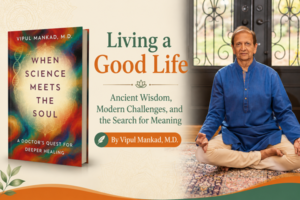
In the process of writing my forthcoming book, “Who Am I?”, my mind has been clarified. If my mind was in pure Satva quality, i.e., lucidity, tranquility, wisdom, discrimination of what is true and untrue, detachment, happiness, peacefulness, and inactivity, there would be no impulse to write this book. However, there is a bit of Rajas mixed with my Satva, which gives my mind and body energetic endeavor, passion, power, restlessness, and creative activity. The analysis has helped me to realize that I have the urge (a Rajas quality) to share my knowledge with the hope that it will help someone else. However, I must give up the ego (अहंकार) that may go with the authorship of this book and dedicate profits to charity. I must give up all attachment to the results of this action of writing the book. I will strive to do just that.
References and Notes:
- Raj Chetty, PhD; Michael Stepner, BA; Sarah Abraham, BA et al, The Association Between Income and Life Expectancy in the United States, 2001-2014, JAMA Volume 315, Number 16, pages 1750-1776, April 26, 2016
- The difference between the male and female gender is through X and Y chromosomes; Y produces the male gender. The Y chromosome is tiny and is 59 million base pairs long. It has only 78 genes. If we look at base pairs, the difference between men and women would be 59 million divided by 3.2 billion or about 1.8%. This translates to men and women being 98.2% the same. Estimating genetic differences between races is more complex in the post-genomic era.
- Noah A Rosenberg, Jonathan Pritchard, James Weber, et al., Science 298: pages 2381-2385, 20 December 2002
- According to bankrate.com, the “average” household expenditure in the USA was $ 72,967 in 2022. That is the actual expenditure for the household. The minimum basic requirement for food, shelter, clothing, and transportation, per person, would be much lower.
- Malik, K. & Haynes-Maslow, L. The affordability of MyPlate: An Analysis of SNAP benefits and the actual cost of eating according to the Dietary Guidelines. Journal of Nutrition Education and Behavior, 49(8), 623-631.
- Bhagavad Gita (2:62-63)
ध्यायतो विषयान्पुंस: सङ्गस्तेषूपजायते |
सङ्गात्सञ्जायते काम: कामात्क्रोधोऽभिजायते || 62||
क्रोधाद्भवति सम्मोह: सम्मोहात्स्मृतिविभ्रम: |
स्मृतिभ्रंशाद् बुद्धिनाशो बुद्धिनाशात्प्रणश्यति || 63||
dhyāyato viṣhayān puṁsaḥ saṅgas teṣhūpajāyate
saṅgāt sañjāyate kāmaḥ kāmāt krodho ’bhijāyate
krodhād bhavati sammohaḥ sammohāt smṛiti-vibhramaḥ
smṛiti-bhranśhād buddhi-nāśho buddhi-nāśhāt praṇaśhyati
As a man contemplates sense-objects, attachment for them arises; from attachment, desire for them will be born; from desire arises anger, from anger comes delusion; from delusion comes loss of memory; from loss of memory comes destruction of discrimination, and from destruction of discrimination he perishes.
- Avadhuta Gita 1:25
तत्त्वमस्यादिवाक्येन स्वात्मा हि प्रतिपादितः ।
नेति नेति श्रुतिर्ब्रूयाद अनृतं पाञ्चभौतिकम् ।।
tattvamasyādivākyena svātmā hi pratipāditaḥ /
neti neti śrutirbrūyād anṛtaṁ pāñcabhautikam //
By such sentences as “That thou art,” our own Self is affirmed. Of that which is untrue and composed of the five elements – the Sruti (scripture) says, “Not this, not this.” (Neti Neti).