For thousands of years, philosophers, sages, and spiritual seekers have wrestled with a timeless question: What is a good life?
The answer is surprisingly elusive. To some, a good life means wealth, power, success, or happiness. To others, it means wisdom, service, love, responsibility, or inner peace. Throughout history, both Eastern and Western traditions have offered different perspectives on what makes life worthwhile.
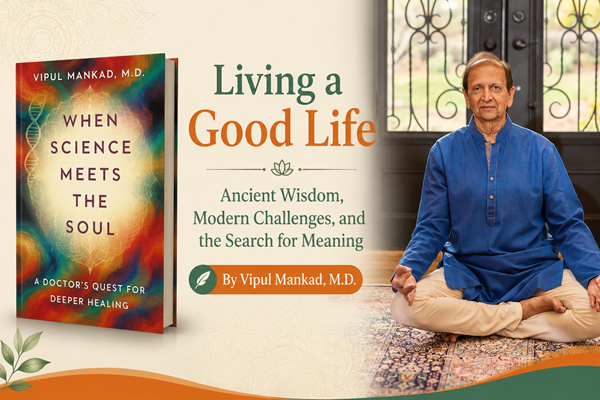
In my recently published book, When Science Meets the Soul: A Doctor’s Quest for Deeper Healing, I explore this question through the lenses of science, philosophy, medicine, yoga, meditation, and spirituality. Here, I offer a brief reflection on some of the ideas that have shaped my own understanding of a life worth living.
The Western Philosophical View
Western discussions of the good life often begin with Socrates, who famously declared that the unexamined life is not worth living. For Socrates, self-reflection was essential. A meaningful life required questioning our assumptions, examining our actions, and striving for self-improvement.
Yet contemplation alone may not be enough. A person quietly meditating in the Himalayas may gain profound insights, but most of us live in families, workplaces, and communities. A good life must somehow include both inner reflection and active participation in the world.
Is Happiness Enough?
Many people equate a good life with happiness. But what kind of happiness?
In Brave New World, Aldous Huxley imagined a society in which people were engineered and conditioned to remain content. The fictional drug Soma kept the population happy while an elite group controlled the social order. Today, with artificial intelligence, biotechnology, pharmaceuticals, and gene-editing technologies advancing rapidly, Huxley’s warning feels less remote than it once did.
A life programmed for constant pleasure would eliminate struggle, growth, moral choice, and the freedom to seek meaning. There is no appreciation of light without darkness, no appreciation of joy without sorrow, and no appreciation of success without failure. The very difficulties we often wish to avoid may be among life’s greatest teachers.
Wealth, Power, and Success
Another common definition of a good life is the accumulation of wealth and power. Money and influence can certainly improve life, create opportunities, and help families and communities. Yet they are means, not ends.
If wealth alone defined a good life, ruthless dictators, criminal kingpins, and unscrupulous billionaires would become our role models. Most of us instinctively reject that conclusion. A truly good life requires something more than accumulation.
Bertrand Russell: Love Guided by Knowledge
Bertrand Russell offered a memorable definition: the good life is one inspired by love and guided by knowledge. This insight remains powerful. Love broadens our concern beyond ourselves, while knowledge helps us understand reality and make wiser choices.
Still, the definition raises an important question. If we pursue happiness only for our own group, nation, race, creed, or ideology, we may unintentionally harm others and the planet itself.
Environmental damage, economic disparities, health inequities, pandemics, and social conflict remind us that a good life cannot be built solely on satisfying our own desires.
Buddha’s Perspective: Understanding Suffering
The Buddha approached the question differently. He observed that suffering is woven into human existence. Even pleasurable experiences eventually end, and their loss can create sadness.
The Four Noble Truths teach that suffering arises largely from attachment and craving. Through self-awareness, discipline, and spiritual practice, we can reduce unnecessary suffering and cultivate inner freedom. While complete elimination of desire may be impossible, understanding our desires can transform our relationship with them.
For me personally, meditation and yogic practices have provided practical tools for reducing anxiety and maintaining balance during a career spent caring for children with life-threatening illnesses.
Expanding the Circle
Today, discussions of the good life often focus on individuals or nations. Ancient Indian philosophy invites us to think more broadly.
The challenges facing humanity – climate change, environmental degradation, pandemics, economic inequality, and conflict – cannot be solved by any one nation acting alone. A good life must include responsibility toward future generations and the larger world we share.
The Vedic Vision: The World Is One Family
One of the most beautiful ideas in the Hindu tradition comes from the Maha Upanishad:
अयं निजः परो वेति गणना लघुचेतसाम्।
उदारचरितानां तु वसुधैव कुटुम्बकम्॥
Ayam nijah paro veti ganana laghuchetasam
Udaracharitanam tu vasudhaiva kutumbakam
This principle expands our moral concern beyond ourselves, our families, our communities, our nation, and our religion. It encourages compassion for all people, respect for all living creatures, and stewardship of the Earth itself.
The Four Goals of Human Life
Classical Hindu philosophy describes four fundamental aims of human existence, known as the Purusharthas.
Dharma means living ethically and fulfilling one’s responsibilities. Artha means pursuing the resources needed to support oneself, one’s family, and society. Kama includes love, beauty, pleasure, creativity, and human relationships. Moksha points toward liberation, spiritual freedom, and realization of one’s deepest nature.
A balanced life embraces all four. It neither rejects the world nor becomes enslaved by it.
The Four Stages of Life
Traditional Hindu thought also describes four stages, or ashramas, through which life naturally unfolds.
Brahmacharya is a period devoted to learning and personal development. Grihastha is the stage of family life, career, responsibility, and contribution to society. Vanaprastha brings gradual detachment from material pursuits and a greater commitment to guiding the next generation. Sannyasa deepens the focus on spiritual growth and inner freedom.
Whether followed literally or symbolically, these stages remind us that the priorities of life evolve over time.
So, What Is a Good Life?
After exploring both Western and Eastern perspectives, I do not believe there is a single, universal formula. A good life is not merely happiness. It is not merely wealth. It is not merely contemplation. Nor is it simply the fulfillment of desires.
A good life is a life of growth, responsibility, compassion, learning, and self-discovery. It balances personal fulfillment with service to others. It seeks meaning while accepting imperfection.
Most importantly, a good life is not a destination that we eventually reach. It is a lifelong pursuit. Even our mistakes, disappointments, and failures can help us become better human beings. In that sense, the good life is not a finished achievement. It is the ongoing journey of becoming.
About the Author and the Book
| Vipul Mankad, M.D. is a physician, scientist, educator, and author of When Science Meets the Soul: A Doctor’s Quest for Deeper Healing. Drawing upon decades of experience in medicine, research, leadership, yoga, meditation, and Indian philosophy, he explores how scientific inquiry and spiritual wisdom can work together to promote deeper healing, mental balance, and a meaningful life. |